
Ask any food manufacturer what keeps them up at night, and somewhere between “will the shipment clear customs on time” and “is this batch consistent with the last one,” you’ll come back to find one word: sourcing. Tomato paste might look like a simple red jar of concentrated flavor, but behind every can, pouch, or drum lies quite a story behind the supply chain, one that starts long before the tomatoes are even picked.
If you’re an importer, distributor, or private-label brand who is looking for a reliable source of bulk tomato paste, this guide is for you. We’ll walk through what actually separates a good tomato paste factory from a great one, what to check before you sign a contract, and why the details you can’t see on a spec sheet often matter more than the ones you can.
Why Tomato Paste Sourcing Is Trickier Than It Looks
Tomato paste is not a commodity that you can buy blind. Two suppliers can quote you the same Brix level and price per ton, and still deliver completely different products. The tomato variety, timing of the harvest, and how quickly the fruit moves from field to factory all have an impact on color consistency, acidity, viscosity, and shelf life, none of which can be understood by a price sheet.
That’s where experience starts to take priority over any marketing copy. A factory that’s been refining its process for over a decade tends to have already made (and fixed) the mistakes that a newer operation hasn’t even encountered yet. FIESTE INDUSTRY, for instance, has spent more than 13 years developing exactly this kind of production discipline, the type of track record that’s hard to fake and even harder to shortcut.
What Actually Makes a Reliable Tomato Paste Factory
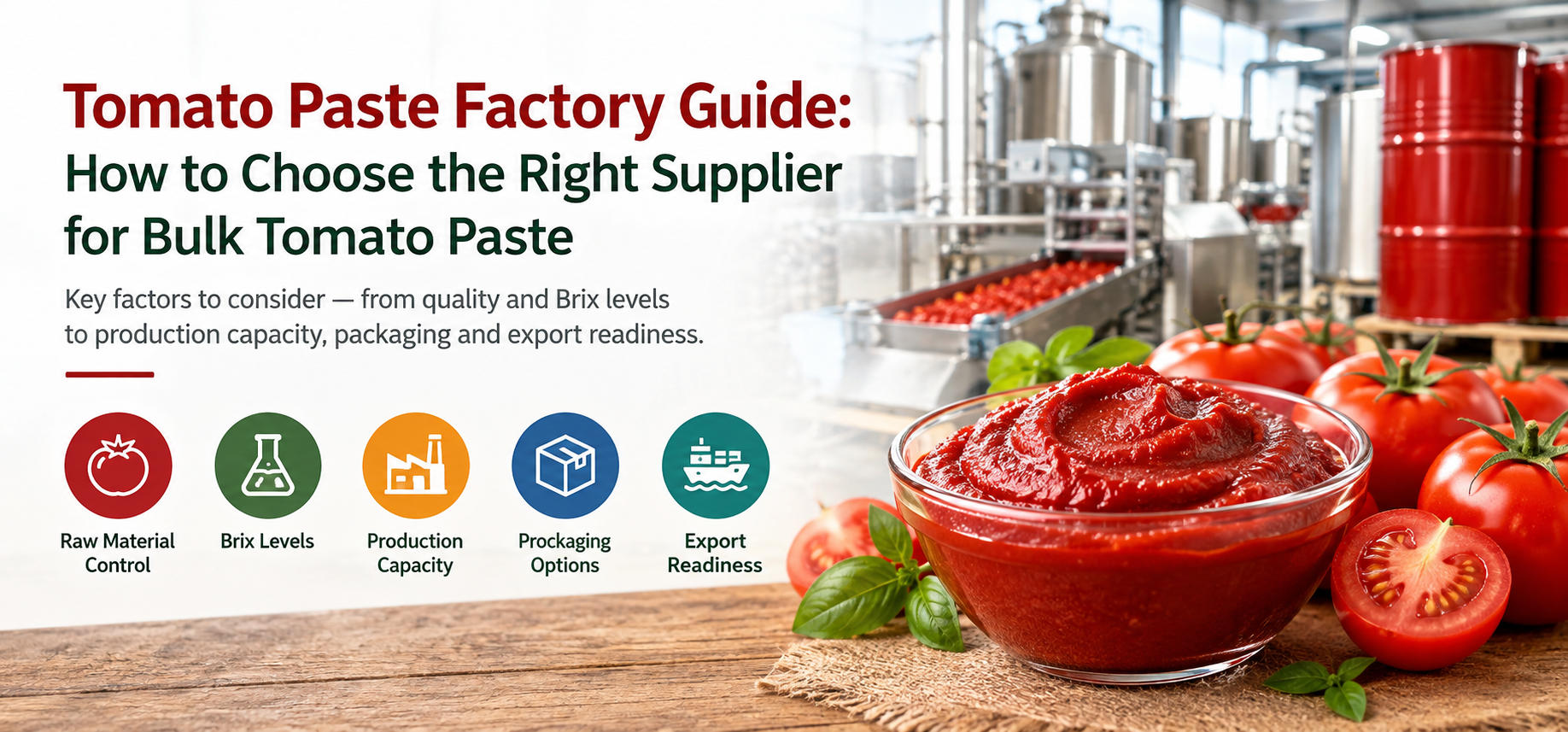
It helps to know what you’re actually evaluating before you commit to a supplier. This is what makes the difference between factories worth partnering with and the ones that look good on paper only:
- Raw material control: Does the factory source tomatoes locally and process them quickly, or are they relying on stored pulp that’s already lost freshness and color?
- A documented production process: A reliable tomato paste factory should be able to guide you through every step, including selection, blanching, pulping, concentrating, and sterilization processes, without leaving any room to hand-wave.
- Consistent Brix options: A good supplier usually offers a range of soluble solids concentrations (commonly 22-24%, 28-30%, 30-32%, and 36-38%), so you can match the product to your exact application.
- Production capacity that matches your order size: A factory with multiple production lines and real daily output numbers is far less likely to leave you waiting during peak season.
- Proximity to a port: Inland factories located hours from the coast can quietly add days (and costs) to your lead time, which is something worth asking about upfront.
- Quality checks at every stage: not just a final inspection before the container is sealed.
None of these are flashy, but together they’re the difference between a shipment that meets spec and one that gets flagged at the receiving dock.
The Bulk Tomato Paste Buying Checklist
If you’re sourcing bulk tomato paste for the first time, or switching suppliers after one too many inconsistent shipments, go through this list and don’t buy from anyone off the list without looking into them first:
- Ask for the full production process, in writing. A factory confident in its operations won’t hesitate to explain it step by step.
- Request samples across Brix levels, not just the one you think you need.
- Confirm packaging flexibility. Can they package flexibly with your order for retail-ready, bulk drums, or aseptic bags?
- Check export experience. A factory that regularly ships to your region will already understand the documentation and compliance quirks that trip up newer exporters.
- Look at capacity versus your volume. A 200,000-package daily output, for example, signals a factory built for consistent, large-scale supply rather than one-off small batches.
- Ask about after-sales support. What happens if a shipment arrives with some faults? The answer to that question tells you more about a supplier than any brochure will.
Why Location Quietly Matters More Than You’d Think
Geography – it’s a factor that’s sometimes overlooked when buying until it costs the buyer. A tomato paste factory located far from a port can rapidly turn a straightforward order into a logistics headache, such as longer trucking times, more handling, and more opportunities for delays. However, factories located closer to shipping routes tend to offer better lead times and more competitive freight costs, which add up fast on bulk orders.
This is one of those details that rarely makes it into a sales pitch but shows up the moment your container is a week late.
Trust, but Verify
There’s a simple filter you can apply to any claim made by any supplier: does the evidence back it up? A factory that claims to have “quality control” should be able to show you what that actually looks like through certifications, inspection stages, real production numbers, not just a slogan on a homepage.
Experience should be demonstrable (how long have they been doing this, and at what scale?), and authority should be backed by something concrete, like export history to markets similar to yours. The suppliers worth trusting are usually the ones who over-explain their process rather than under-explain it.
Choosing a Long-Term Partner, Not Just a One-Time Order
The best relationships with a tomato paste factory rarely start with the biggest order; they start with the right questions. And for suppliers like FIESTE INDUSTRY that have built their reputation on consistency across hundreds of shipments and dozens of countries, that scrutiny is welcome, not a hurdle.
Bulk tomato paste sourcing doesn’t have to feel like a gamble. With the right checklist, the right questions, and a supplier willing to be transparent about their production process, it becomes exactly what it should be: a dependable, repeatable part of your supply chain.
Frequently Asked Questions
1. What Brix levels are typically available from a tomato paste factory?
Most established factories offer a range of soluble solids concentrations, usually 22-24%, 28-30%, 30-32%, and 36-38%, so buyers can select the concentration that best fits their formulation needs.
2. How do I know if a supplier can handle bulk tomato paste orders reliably?
Look at their production capacity, their export history, and whether they can provide documented, repeatable processes. A supplier with consistent large-scale output is generally better equipped for recurring bulk orders.
3. Does factory location really affect delivery timelines?
Yes. Factories located closer to seaports usually offer shorter lead times and lower freight costs compared to those further inland, which can meaningfully affect your total landed cost on large orders.
4. What packaging options should I expect for bulk tomato paste?
Reliable suppliers usually offer flexible packaging so you can match packaging to your distribution channel without renegotiating your entire order.
5. What red flags suggest a tomato paste factory isn’t a good long-term fit?
Vague answers about production processes, no clear quality control checkpoints, limited sample availability, and a lack of export documentation experience are all signs worth taking seriously before committing to a partnership.